National Foundation on the Arts and the Humanities Act of 1965 Pl 89209
In our hands
14 July 2014 –
Editor'due south Note: This is the second piece in a series on the "crisis" in the humanities. A postal service introducing the series can exist establish here.
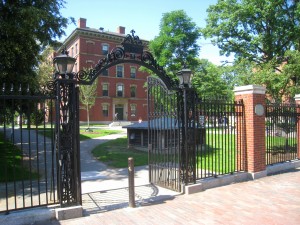
Bradstreet Gate, Harvard Yard, Harvard University, Cambridge, Massachusetts. Photograph credit: Daderot, Wikimedia Commons
Not long ago I was invited to a small university in California to talk well-nigh the crisis in the humanities. When I arrived I was greeted past a professor of philosophy, kinesthesia members from the literature department, and a historian. We sat together in a small classroom overlooking a peaceful, park-similar setting. Only they all seemed worried, and then I asked them how things were at their university.
"Well," they said, "things were not going well." Pupil enrollment in humanities courses and the number of majors were down. The president had reeled in a multimillion dollar souvenir, but none of it would be earmarked for the humanities. You could hear in their tense voices that they felt they were living in crisis. I pointed out that they might feel similar in that location was a crisis at their university, but the humanities outside of the academy were non in crunch–in fact, they were in neat demand. It was an awkward matter to say, but there actually is a gulf between the fate of the humanities inside and outside academia.
We have been hearing for a long fourth dimension that the humanities in academia are threatened. A 2009 survey fueled by the American Academy of Arts & Sciences' Humanities Indicators database pointed out that the humanities share of higher degrees is less than one-half of what it was during the heyday of the mid-to-tardily '60s. Facing this bad news, one has to ask if anything tin can exist done.
One of the keys to reversing the trend is to take our instance to the American people. This is what the American Academy did with its follow-upwardly report, called the Heart of the Matter. When I brought up the Heart of the Matter written report to the kinesthesia members, still, it was met with derision and snickers. It seemed that while they bemoaned the reduction in their enrollments and majors, they did not want to seek help beyond their inward-looking traditions. Maybe their negative reaction was because the study was widely covered in the popular media, gaining more than coverage for the humanities than I have seen in the past ten years. Perhaps information technology was because Richard Brodhead, the co-chair of the report, appeared on the Colbert Written report. Information technology seemed these academics would accept help only from what they narrowly considered to be scholars.
I would argue to skeptical academics that we in the humanities cannot afford to dismiss efforts to bridge the gap between the life of the humanities in academia and beyond its walls. Though the number of majors inside humanities departments may be on the decline, the style to bargain with this is not to wait inward, only outward, to attain beyond ivy walls to surrounding communities to demonstrate why the humanities thing. My feel has taught me that there is both a need and a desire, one might even say a hunger, in many communities for the knowledge and wisdom we all know the humanities offer.
I take watched Iraqi Chaldeans in San Diego working to create a moving picture that explores what it means to exist a refugee and to surrender so much to live in the US. I have witnessed people at the Riverside County Library in Coachella Valley, California, in lively discussion of "A Litany for Survival" by poet Audre Lorde, contemplating the irrepressible question of what it ways to live the good life. I have talked to staff at the Veterans Affairs Hospital of Central California, which serves 35,000 veterans, who come together to read about and analyze in man terms the traumatizing experiences of war. In that location are hundreds of institutions similar these (museums, libraries, schools, and community-based nonprofit organizations) beyond California and the nation that I know are eager to benefit from the noesis and facilitation of scholars and engagement from universities in their searches for meaning.
Sadly, and despite this evident hunger for humanities content and discussion, I find an academy that is often reluctant to back up and reward the engagement of scholars and its students across the walls of tradition and sometimes impenetrable scholarship. Is there some mode to kicking start a healthy building of bridges between academia and society? Perhaps there is. Scholars and their institutions are not solitary nor as alone every bit they might now feel.
The National Endowment for the Humanities (NEH) was founded on the belief that "democracy demands wisdom and vision in its citizens." The agency promotes access to the humanities for people of all backgrounds no matter where they are located. The founders of NEH urged that the organization encourage "the relevance of the humanities to the current conditions of national life."[1] We must ever ask whether information technology is doing enough to connect the people of the Usa with the power of the humanities. And whether it is doing enough to connect communities with academia.
Although faculties in academia are skeptical and discouraged today, there is an opportunity to use the energy, volition, and hopes of students to turn around the fateful crisis of humanities departments. This might mean irresolute the style we educate humanities students. I recently spoke to humanities graduate students from across the University of California system about their futurity work prospects. The chat was tough considering many of them had been focused on getting their doctorates, so they had been removed from the broader workforce for iv to ten years. Sure, they had developed disquisitional thinking and writing skills, likewise as the ability to consider a variety of opinions and ask the right questions. However, when an employer reads their resume, the person who had been in graduate schoolhouse volition frequently exist seen as overqualified, or worse, out of bear upon. We know that only 40% of these graduate students will continue to tenure-track positions, the rest, a great majority, will do other things. Can we see this as an advantage rather than a failure?
Why can't we in the humanities acknowledge this massive change and construct systems that set up our students for what a majority of them volition exercise – work outsides the confines of academia? In other words, why tin can't nosotros organize humanities education and then that our best and brightest learn about work exterior of academia – at a state humanities council, public television or radio station, a loftier tech start-up geared to learning, a museum or theater company? Why are nosotros in the humanities reluctant to connect exterior of the university?
The fate of the humanities is in our easily. Communities are doing their part to host humanities programs to increase individual and communal agreement of the power of the humanities. Academia should practise its part to support interested individuals, scholars, and students working beyond the walls of academia. Without this support, both society and the humanities will endure. With communities and academia working together, nosotros tin can reach forward to a new historic period of the humanities in our club. This is the kind of effort that makes life worth living and volition ultimately salvage the humanities.
~ Ralph Lewin is onetime President & CEO, Cal Humanities
[1] National Endowment for the Humanities, National Foundation on the Arts and the Humanities Human action of 1965 (PL 89-209).
Source: https://ncph.org/history-at-work/in-our-hands/
0 Response to "National Foundation on the Arts and the Humanities Act of 1965 Pl 89209"
Postar um comentário