Youre Locked Out Enter the Recovery Key to Get Going Again
Z7_3054ICK0KGTE30AQO5O3KA30N0
hp-concentra-wrapper-portlet
 Deportment
HP PCs - Using BitLocker or Finding the Recovery Cardinal (Windows ten)
This certificate is for HP computers that back up BitLocker Bulldoze Encryption or Device Encryption.
Device encryption prevents unauthorized individuals from accessing your device and information. Your estimator might support BitLocker Drive Encryption (in English) or Device Encryption (in English language).
You tin can check whether your device supports standard BitLocker encryption or Device Encryption.
Be sure to save your recovery primal, considering it might be required after certain actions, such as a BIOS update.
Information protection with BitLocker Bulldoze Encryption
BitLocker Drive Encryption is also known every bit standard BitLocker encryption.
BitLocker Bulldoze Encryption is available on supported devices running the Windows 10 Pro, Windows 10 Enterprise, or Windows 10 Instruction operating systems.
note:BitLocker Drive Encryption is not available on devices running the Windows ten Home operating system.
If your device uses BitLocker Drive Encryption to encrypt your data, you lot must activate BitLocker.
During the activation procedure, you can select where to store the recovery key. This manual recovery primal backup procedure is initiated when BitLocker is turned on.
Data protection with Device Encryption
Device Encryption is a feature-limited version of BitLocker that encrypts the entire system. Device Encryption is also known as BitLocker Device Encryption or BitLocker Automatic Device Encryption.
Device Encryption is available on supported devices running whatsoever Windows 10 operating organisation. It requires a TPM and Modern Standby support.
Windows automatically enables Device Encryption on devices that support Mod Standby (in English language). Microsoft offers Device Encryption support on a broad range of devices, including devices that run Windows 10 Home edition. See Overview of BitLocker Device Encryption.
Device Encryption is enabled automatically when you either sign into your device with a Microsoft account or join with a corporate domain business relationship.
The recovery key is uploaded to the Microsoft business relationship or the corporate domain automatically.
Enabling BitLocker Drive Encryption or Device Encryption
Enabling BitLocker Drive Encryption
-
Sign in to Windows with an administrator account.
-
In Windows, search for and open up Manage BitLocker.
-
Click Turn on BitLocker, and and then follow any on-screen instructions.
-
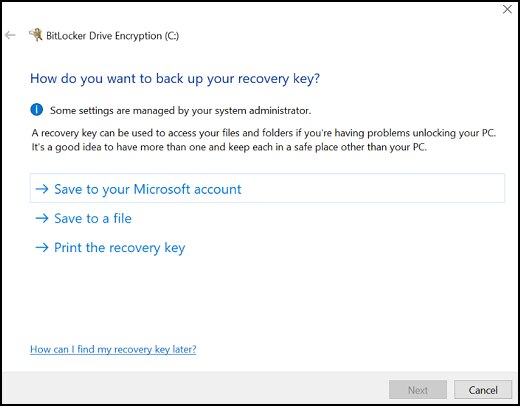
When prompted, select an choice to back up your recovery key.
notation:
Y'all can back up the recovery central later, if necessary. In Windows, search for and open Manage BitLocker, and and then click Back up your recovery key.
-
Follow the onscreen instructions for your selected backup method. The options might vary depending on your BitLocker type.
notation:
Microsoft does not recommend printing recovery keys or saving them to a file. Instead, Microsoft recommends using an Active Directory backup or a cloud-based fill-in. Cloud-based backup includes Azure Active Directory (Azure AD) and your Microsoft business relationship.
-
Relieve to your Microsoft account: Relieve the recovery fundamental to your Microsoft business relationship, to be accessed online.
-
Save to your cloud domain business relationship: Save the recovery fundamental to your company'southward cloud domain.
-
Save to a USB flash drive: Save the recovery fundamental to a removable USB wink drive.
-
Save to a file: Save the recovery key to a .txt file stored on your computer hard bulldoze.
-
Print the recovery fundamental: Print a copy of the recovery primal and store it in a prophylactic location.
-
-
Later on saving the recovery key, follow the on-screen instructions to terminate the BitLocker Bulldoze Encryption process.
Enabling Device Encryption
Device Encryption tin be enabled during your initial reckoner setup or any fourth dimension after by signing in with your Microsoft account or by joining a domain.
Enabling Device Encryption during computer setup using a Microsoft account
-
Follow the on-screen instructions to prepare your computer.
-
Later agreeing to the Finish-User License Agreement (EULA), you lot are prompted to add or create your Microsoft account. Enter the email, telephone number, or Skype username associated with your Microsoft account and and then click Next, or click Create account and follow the on-screen instructions.
-
Enter your countersign, and then click Next.
-
Follow the on-screen instuctions to complete your computer setup.
-
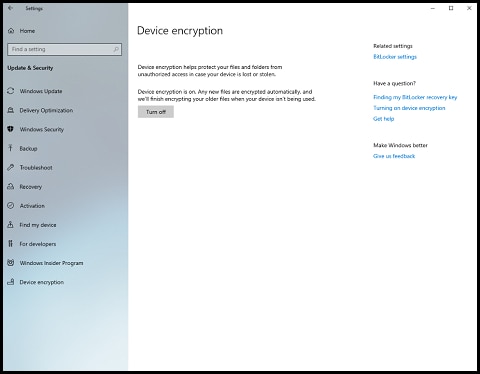
Afterwards your computer setup is complete, you can verify that Device Encryption is enabled. In Windows, search for an open Settings.
-
Select Update & Security, and and then select Device encryption. Device encryption is on and encrypting all nowadays files and any files added to the system.
note:
In improver, if you search for an open File Explorer, a lock icon is displayed on the operating organization drive.
Enabling Device Encryption afterwards computer setup using a Microsoft account
-
Sign in to Windows with an administrator account.
-
In Windows, search for and open Settings, select Update & Security, and then select Device encryption.
-
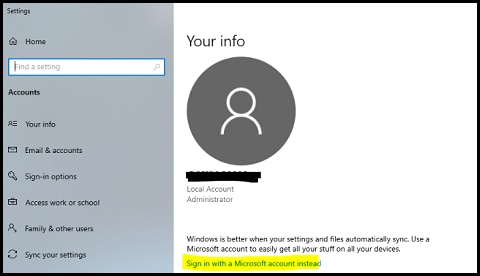
Click Sign in with a Microsoft account instead. The Accounts folio opens.
note:
If Device Encryption is enabled but has been turned off, click Plough on.

-
On the Accounts page, click Sign in with a Microsoft account instead.
-
Enter the email, telephone number, or Skype username associated with your Microsoft account and then click Side by side, or click Create account and follow the on-screen instructions.
-
Enter your password, so click Next.
-
Follow the on-screen instructions to finish your account setup, and and then sign in to your Microsoft business relationship.
-
After your figurer setup is consummate, you can verify that Device Encryption is enabled. In Windows, search for an open Settings.
-
Select Update & Security, and then select Device encryption. Device encryption is on and encrypting all nowadays files and any files added to the organization.
notation:
In add-on, if you search for an open File Explorer, a lock icon is displayed on the operating system bulldoze.
Using the recovery primal
Computers encrypted with BitLocker Bulldoze Encryption or Device Encryption might require the entry of a recovery primal subsequently one of the post-obit events:
-
BIOS update
-
A Microsoft Push Button reset
-
Disabling Secure Kick or Trusted Platform Module (TPM)
-
Hardware changes such as calculation or removing video or network cards
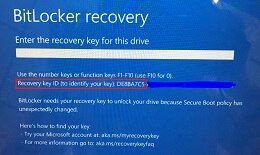
Commonly, you dorsum up your recovery key when BitLocker is enabled. If you are enabling BitLocker Bulldoze Encryption, manually select where to store the recovery key during the activation process. If you are enabling Device Encryption and you log in to your estimator using a Microsoft account, the encryption starts automatically and the recovery key is backed up to your Microsoft business relationship.
Retrieve, and then enter the recovery key to commencement continue using your computer over again.
Retrieving the recovery cardinal from your Microsoft account
When you sign in using a Microsoft account, Device Encryption starts automatically. If yous utilise BitLocker Bulldoze Encryption, you must have manually saved the recovery central to your Microsoft account to utilize this procedure. If in that location is a problem and you are unable to sign in, y'all must employ the recovery key to sign in.
-
In the Microsoft account option, click Sign in.
-
Follow the on-screen instructions to log in to your Microsoft account.
-
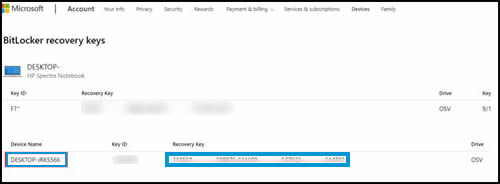
If you take multiple computers, yous can identify the correct fundamental past matching the Device Name.
-
Your recovery key is the recovery central with a Device Name that matches the Recovery key ID on the recovery prompt.
-
Type the recovery key into the Enter the recovery primal... field in Windows, and and then click Continue.
-
Sign in with the Microsoft account you use on the reckoner that requires a recovery key.

-
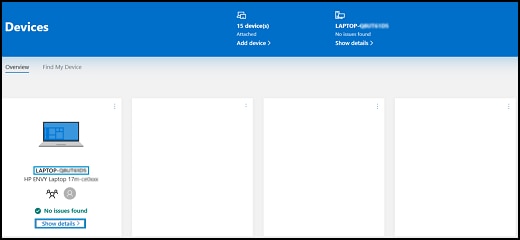
Click All Devices, locate the device proper name that matches the computer with the encryption issue, and then click Show details.
-
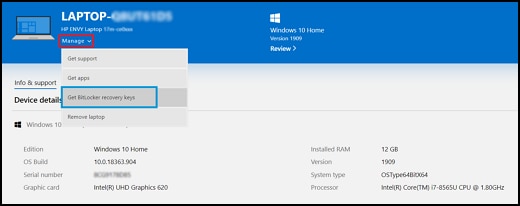
Click Manage, and then select Go BitLocker recovery keys to get the key.
-
Your recovery key is the recovery central with a Device Proper noun that matches the Recovery key ID on the recovery prompt.
Source: https://support.hp.com/lt-en/document/c06432394
0 Response to "Youre Locked Out Enter the Recovery Key to Get Going Again"
Postar um comentário