How Do I Read My Boat Hin#
Hull Identification Numbers
Confusion over model years, particularly on outboard engines, can frustrate buyers. Hither'south how to find that info on the products themselves.
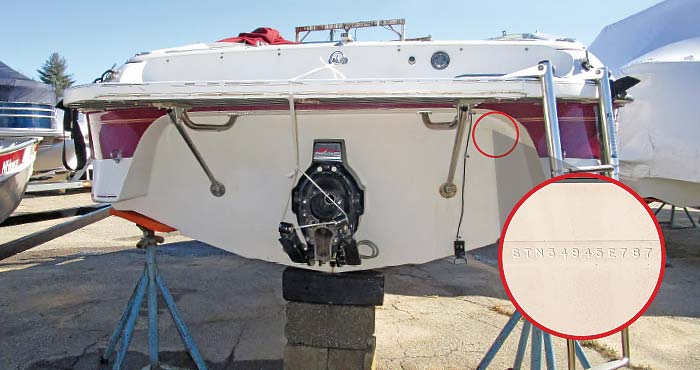
Photo: Mark Corke
General Motors introduced planned obsolescence in the 1920s every bit a way of discerning one model year from some other, in order to convince the public that buying the latest model machine was fashionable, if not exactly necessary. The tradition fix by GM survives today. Somewhen, consumers began to rely on the model-year modify, which usually happened in the fall, to assure that they were getting the latest and greatest. Car buyers yet eagerly conceptualize the newest technology, and dealers often offer deep discounts to motion out last yr's models.
Manufacturers of other big-ticket items, such equally boats and outboards, followed suit, hoping to convince buyers that the newer the boat, the better the boat. For years, U.Southward. Declension Guard regulations required boat manufacturers to apply Baronial 1 of the previous twelvemonth as the cutoff appointment for the next model year. For example, a gunkhole congenital in September 2011 could be chosen a 2012 model, but if it was congenital in July, it had to be sold as a 2011.
Tip
When buying a used boat, take a rubbing of the boat'south HIN using a pencil and paper to ensure it matches the seller's documents.
In 2012, boatbuilders petitioned the Coast Guard to change the date to June 1, allowing for an actress two months of production to yet be labeled as next yr'due south model. Manufacturers argued that because of marine production schedules, which, dissimilar automaker schedules, tend to fall at erratic times throughout the twelvemonth, they needed to have more flexibility in designating the time span of their new model year.
The Coast Guard agreed to make the alter, permitting a couple of months of terminal year'due south boats to exist called this twelvemonth's.
Fortunately, it's adequately simple to find your boat's build date. (Run into "HINs Past The Numbers" below) The information with the gunkhole's model year is independent in the hull identification number (HIN), which is a label permanently affixed to the boat. The number includes a engagement assigned by the architect. This date is technically not the date of industry; rather, it'southward the date on which the boat was certified by the builder to meet Coast Baby-sit regulations.
HINs By The Numbers
A typical hull identification number (HIN) consists of 12 letters and numbers, as in ABC12345D404.
Here's what the messages and numbers mean:
ABC: This is the U.Due south. Coast Guard-assigned manufacturer identification code (MIC). Go to the USCG Manufacturers Indentification folio to access the Declension Guard'southward MIC database.
12345: This is the serial number assigned to the hull by the manufacturer. This may be a combination of letters and numbers. The letters "I," "O," and "Q" are excluded considering they could exist mistaken for numbers.
D: This is the month of certification, indicating the month in which construction began. "A" represents January and "L" represents December. In our example, "D" means April.
iv: This is the twelvemonth of certification. The number is the terminal digit of the yr in which the gunkhole was built. "iv" in this case designates 2004.
04: This indicates the boat's model year.
Some boats, especially large ones, may exist on the floor for months before completion (even straddling the June cutoff appointment), while others may be finished in a matter of days. To be consequent, the Coast Guard uses the date the manufacturer says the boat meets federal regs. Once the HIN is assigned and affixed, that date becomes the boat's model year, regardless of when it was really finished.
Once a HIN has been put on the gunkhole, it tin can't be inverse without permission from the commandant of the Declension Guard, which rarely happens. New boat buyers should wait at the HIN and verify that the boat in which they're interested actually belongs to the model year that the dealer claims for it. Used-boat buyers should also decipher the HIN and brand certain it matches what the seller and paperwork state.
What About My Engine?
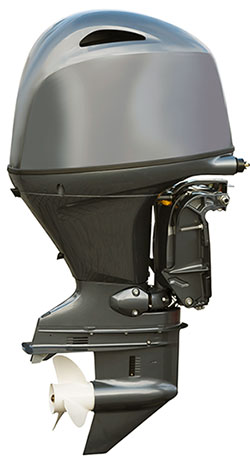
The month and year of engine industry can
usually exist found on a sticker near the engine'south
serial number.
The Coast Guard has no model-year regulations for outboard engines, making it harder for consumers to decide the year in which they were built. In 2007, Yamaha stopped designating model years for its outboard engines entirely. Though the reasoning is sound, it creates a challenge for consumers.
Unlike cars, in which engines are congenital into the product, a selection of engines normally can be fitted on outboard boats. Dealers take struggled for years to make sure that the engines bought from an engine manufacturer during 1 year get sold that aforementioned year on new boats.
If a gunkhole on the showroom flooring comes with a 200-hp engine only a buyer wants a 250-hp engine, the dealer may have to order the bigger engine and keep the smaller one in stock. If it takes a couple of years to finally sell that 200-hp engine, a buyer may be reluctant to purchase it if the model yr isn't electric current, and the dealer may have to subsequently disbelieve it. Buyers typically want a 2017 engine, for example, on their 2017 boat.
Eliminating the model year solves the problem for the manufacturer and dealer but can be confusing for buyers. Other outboard manufacturers, including Mercury and Honda, adopted Yamaha'due south do, and nearly outboard engines today don't accept model-year designations. Outboard manufacturers say that until they make a significant change to an engine, the year it was congenital is irrelevant. While that's truthful, buyers are concerned that if there's no model-year designation, they don't know if they're getting the newest technology.
Fortunately, in that location's still a way to determine when an outboard was built. Later discontinuing model years, engine manufacturers replaced the model-year designator on the engine's serial number with a code that signifies an "era" in which all engines are supposed to exist the same, with similar upgrades. Consumers, however, are concerned that with reckoner controls, mechanically identical engines could take electronic updates applied to a batch of like models, and earlier ones might not benefit.
What'south considered an upgrade? In the finish, the engine manufacturer gets to decide what it is and when there'due south enough of 1 to create a new model. Fortunately, dealers normally know which engines in their stock have the most current changes, and you lot should ask before ownership.
What Most Warranties?
Manufacturers say that the warranty begins when the engine is sold, regardless of its build date. BoatUS members accept asked BoatUS Consumer Protection nigh engines that may have been sitting around for ii or three years. What if they've been damaged over time? By unknowingly buying an engine that may exist 1, ii, or even iii years older than their new gunkhole, will they be hit with higher depreciation when it comes time to sell their gunkhole?
Fortunately, the manufacturer's warranty will embrace even older engines of the same model, but buyers should verify how many hours are on an engine before buying it. Manufacturers say that depreciation should not be an issue on 2 identical engines of the same model, regardless of age, only almost buyers want the newest i available, and an older engine, even if it'south indistinguishable from a newer one, is typically worth less to a offset or second buyer.
The good news for consumers is that while outboard engines may non take model years, it's possible to find out when the engine was made. In recent years, a permanent sticker typically tin exist plant on the transom bracket, usually near the serial-number sticker, that gives the calendar month and year of engine manufacture. As a buyer, you tin negotiate for the newest engine — or for a discounted older one — if you know what to look for.
Writer
Charles Fort
Contributing Editor, BoatUS Magazine
Charles Fort is BoatUS Magazine's West Coast Editor. He often writes local news items for BoatUS Magazine'south Waypoints column and contributes to Reports, in-depth tech features in every issue written to help readers avoid adventitious damage to their boats. He is a member of the National Association of Marine Surveyors, he's on ABYC tech committees, and has a 100-ton U.S. Coast Guard license. He lives in California.
BoatUS Magazine Is A Do good Of BoatUS Membership
Membership Benefits Include:
-
Subscription to the print version of BoatUS Mag
-
four% dorsum on purchases from Due west Marine stores or online at WestMarine.com
-
Discounts on fuel, transient slips, repairs and more at over one,200 businesses
-
Deals on cruises, charters, auto rentals, hotel stays and more…
-
All for just $25/year!
Source: https://www.boatus.com/expert-advice/expert-advice-archive/2017/february/hull-identification-numbers
0 Response to "How Do I Read My Boat Hin#"
Postar um comentário